BESS Fire Safety and Thermal Management Explained
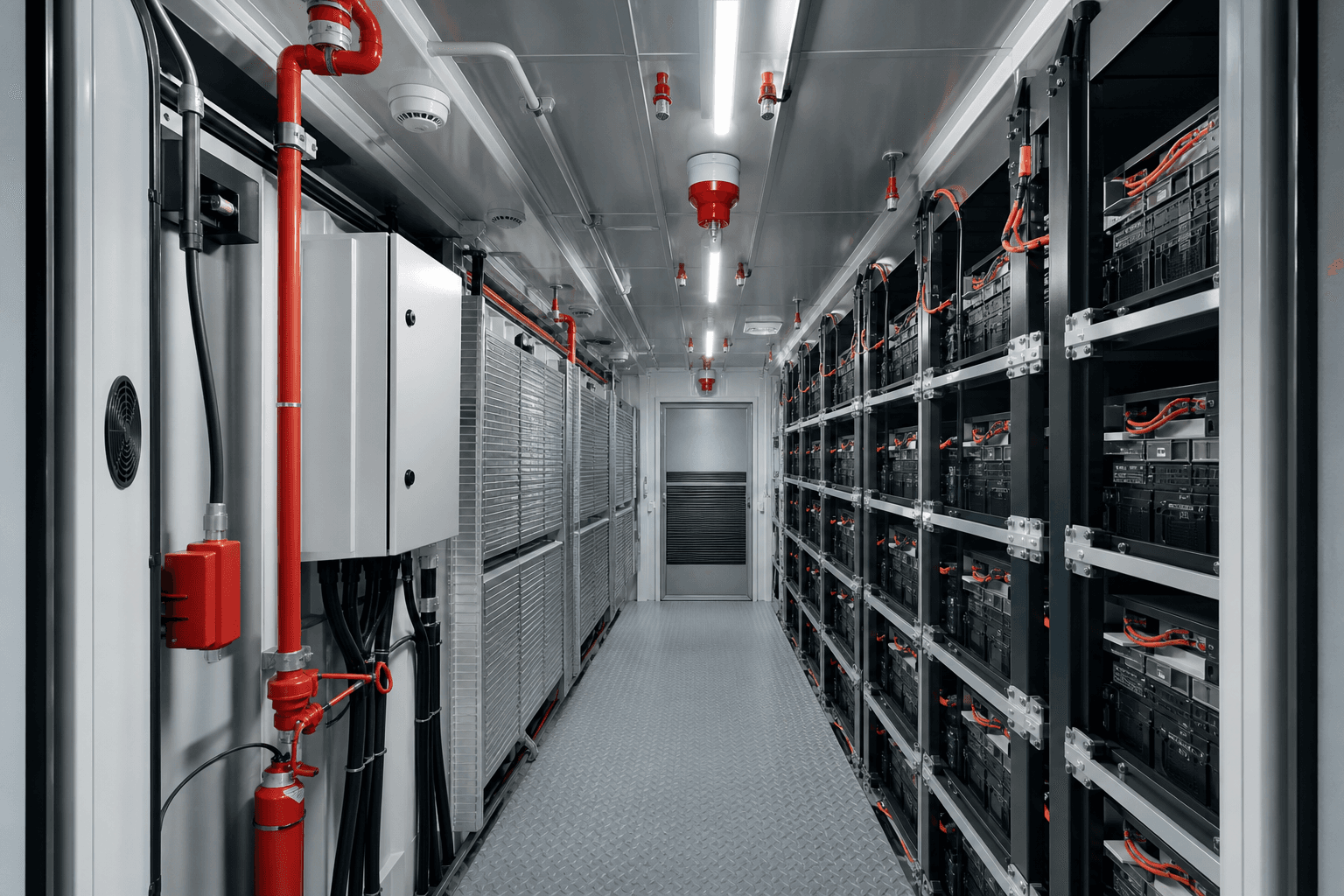
BESS fire safety starts with good system design — the right battery chemistry, enclosure design, thermal management, BMS, fire detection, emergency shutdown, system spacing and O&M strategy, all built in from the beginning.
What is thermal runaway?
Thermal runaway is a condition where a battery cell overheats and triggers further heat generation. If not properly contained, it can spread from cell to cell, creating a fire-propagation risk. UL 9540A is a test method designed to meet fire-safety and building-code requirements for BESS by understanding how a system behaves under extreme conditions, including heat, gas release and fire propagation.

Why thermal management is critical
Battery performance is highly sensitive to temperature. Operating outside the ideal range can cause:
- Faster degradation and reduced usable capacity
- Lower efficiency
- Higher failure and fire risk
- More downtime
- Reduced warranty protection
Key components of BESS fire safety
A safe BESS combines several layers: a Battery Management System (first layer of protection, monitoring voltage, current, temperature, SOC and SOH); a thermal management system (air or, increasingly, liquid cooling for better temperature uniformity); a fire detection system (smoke, heat and gas detection with alarm integration); a fire suppression strategy suited to the design and chemistry; emergency shutdown to isolate faults; and safe site layout with container spacing, access roads, drainage, boundary distance and emergency-response planning.
A common mistake: looking only at battery brand
A good battery brand is important but not enough. Fire safety depends on the full system — cell, module, rack and container design, BMS, PCS, EMS, cooling, fire system, installation quality, commissioning, O&M and remote monitoring. A BESS project is only as safe as its weakest layer. For Malaysia’s hot, humid climate, thermal management is especially important.
Frequently Asked Questions
It is when a battery cell overheats and triggers further heat generation that can spread between cells if not contained.
A test method used to evaluate fire and thermal-runaway behaviour of battery energy storage systems against fire-safety and building-code requirements.
The hot, humid climate makes temperature control essential to protect battery safety, performance and lifespan.
Related reading
Keep exploring — more from the Solunar Knowledge Centre:
Have a Solar + BESS project to discuss?
Solunar supports EPCC companies, developers and asset owners with technology, integration and O&M.